
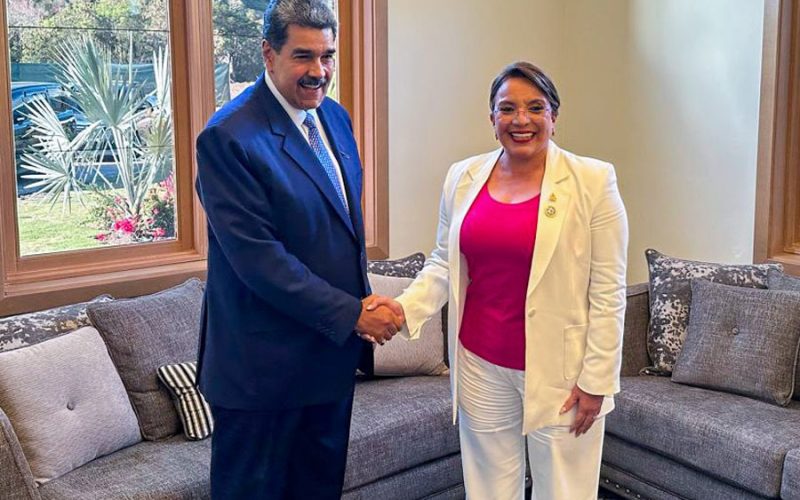
The possibility of Nicolás Maduro’s capture and overthrow is shaping up to be an event with direct repercussions for the LIBRE Party, creating a scenario of political and institutional uncertainty in Honduras. The historical and strategic links between the ruling party and the Venezuelan regime could place the party in a vulnerable position vis-à-vis international opinion and local political actors.
Links between LIBRE and Chavismo
For years, various analysts have pointed to the existence of ideological and strategic connections between the LIBRE Party and the Maduro government. These relations range from political affinity to cooperation in areas of strategic exchange, creating a frame of reference that today places the party under international scrutiny. Maduro’s eventual fall is expected to turn the world’s spotlight on Tegucigalpa, evaluating the ruling party’s position and ties to Chavismo.
In this context, members of the opposition have intensified their statements, raising scenarios of instability: “If Caracas falls, Tegucigalpa will fall,” is heard in political circles, a phrase that sums up concerns about the potential impact of Venezuela’s collapse on the country’s governability.
Implications for political stability
The LIBRE Party faces the need to strike a balance between its international projection and internal stability. Experts agree that, in the face of drastic change in Venezuela, the perception of the ruling party could be affected at different levels: from its credibility with multilateral organizations to the confidence of citizens in institutions. The current situation places the country in a position where the decisions of the ruling party will have a direct effect on political polarization and institutional legitimacy.
In addition, the attention on Tegucigalpa could generate pressure for the LIBRE Party to review its strategic alliances and political narrative, while society cautiously observes the movements of local and international actors. Governance thus becomes a central issue, where the ruling party’s responsiveness will determine the level of stability that can be maintained in the coming months.
Potential developments and organizational challenges
The collapse of the LIBRE Party‘s strongest ally raises questions about the sustainability of its political strategy and the strength of its institutional ties. The potential onset of a “domino effect” could influence the dynamics of political parties, citizen mobilization, and the perception of control mechanisms and state oversight. Likewise, the relationship between Honduras and international organizations could undergo a readjustment as the ruling party’s position on the Venezuelan crisis is evaluated.
In Honduran society, expectations regarding changes in Venezuela are translating into a climate of political tension that demands vigilance over institutional transparency and the government’s responsiveness. The situation points to a period of complex challenges, where the interaction between foreign and domestic policy will be decisive for the stability of the country.